
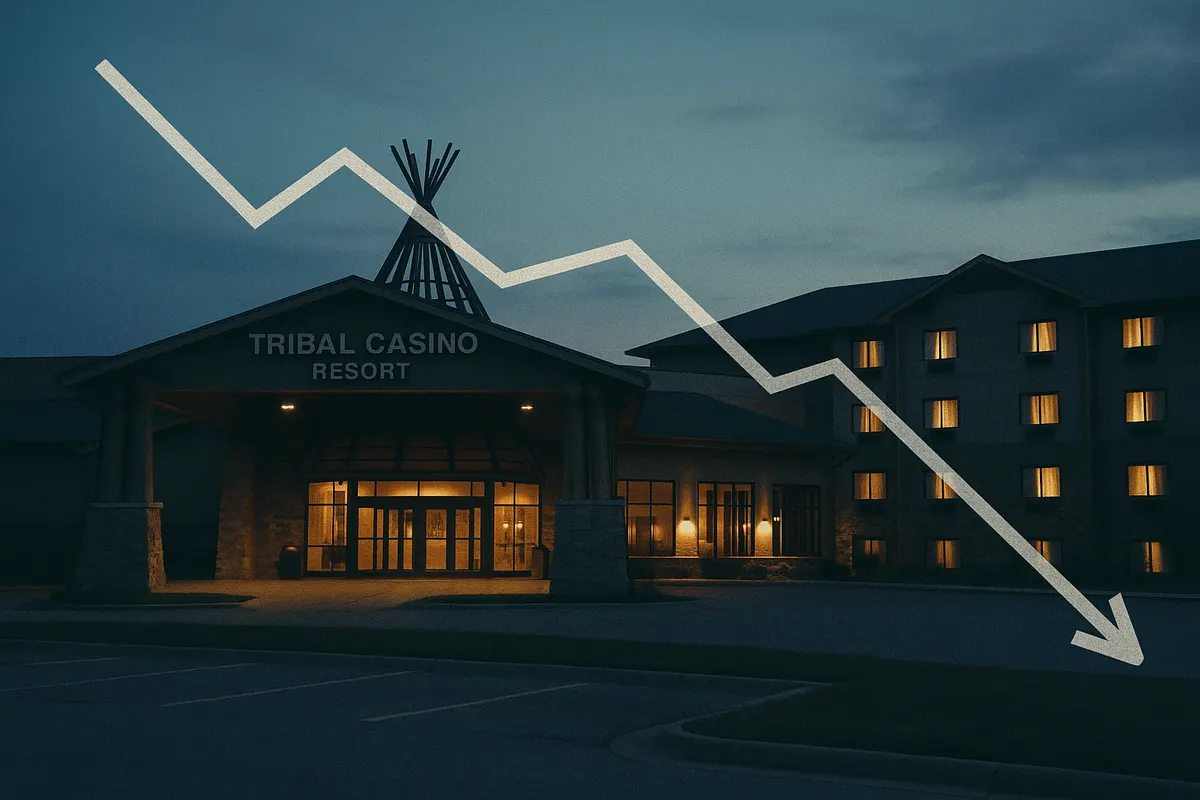
Michigan collected $52.8 million in tribal casino revenue sharing in 2022. In 2025 it collected $15.4 million. That is a 71% collapse in three years, and almost none of it is explained by people gambling less.
The honest reading of the michigan tribal casino payments story is that this is a contract fight, not a business downturn. Michigan’s tribes sold the state a share of their slot revenue in exchange for a promise: limited competition. The state then legalized online lottery games, online casinos and sports betting, expanded horse racing, and now faces prediction markets. The tribes’ response has been to stop writing cheques and let the lawyers sort out what exclusivity was ever worth.
What a revenue-sharing deal actually is
Tribal gaming in the US runs on compacts, negotiated agreements between a tribe and a state government that set the terms for Class III casino games. In Michigan, the core bargain was simple enough to fit in a sentence: tribes hand over a percentage of revenue from slots and other electronic games, and in return the state agrees to varying degrees of protection from competing gambling.
Those state-level payments flow into the Michigan Strategic Fund, which helps finance the Michigan Economic Development Corp. Since revenue sharing started, tribes have put more than $1.1 billion into that fund, according to Crain’s Detroit Business. It is real money that has been underwriting economic development programmes for decades.
Note the phrase “varying degrees.” Exclusivity was never absolute, and the compacts were written when the competitive threat looked like another brick-and-mortar casino down the highway, not a slots lobby on every phone in the state. That ambiguity is the whole dispute.
The erosion, in order
Each step was defensible on its own. Stacked up, they look to the tribes like the state selling the same exclusivity twice.
- 2014: the Michigan Lottery launches online games. Gun Lake Tribe withheld payments over it, arguing the iLottery breached its exclusivity rights. The state disagreed, and the two sides reached a partial settlement in 2016.
- 2019: Michigan legalizes online casinos and sports betting, putting commercial operators and tribal brands into direct digital competition statewide.
- Since then: horse racing expansion, and more recently prediction markets offering event contracts that look a lot like betting to anyone who has ever placed a bet.
So the 2014 fight was the template. What changed is the scale: one tribe disputing one product has become most of the state’s tribes disputing the entire direction of Michigan gambling policy.
Who is still paying
The withholding has rolled through the state tribe by tribe. The most consequential domino fell in late September, when the Pokagon Band of Potawatomi Indians, operator of the Four Winds casinos, joined the list, as Crain’s Detroit Business first reported.
| Tribe | Casino | State revenue-share status | Last reported state payment |
|---|---|---|---|
| Hannahville Indian Community | Island Resort & Casino | Paying in full | About $644,000 (2025) |
| Pokagon Band of Potawatomi Indians | Four Winds | Stopped September 2026 | $11.7 million (2025) |
| Nottawaseppi Huron Band of the Potawatomi | FireKeepers Casino Hotel | Stopped February | $18.5 million (prior year) |
| Gun Lake Tribe | Gun Lake Casino Resort | Stopped 2025 | Not disclosed |
| Little River Band of Ottawa Indians | — | Stopped 2023 | Not disclosed |
| Other Michigan tribes | — | Stopped years earlier | — |
Hannahville is now the only tribe making full state revenue-sharing payments, at roughly $644,000 for 2025. Set that against a 2022 baseline of $52.8 million and the picture is clear: once the Pokagon money is gone, the state-level revenue share is effectively a rounding error rather than a funding stream.
The MEDC is the one feeling it
The immediate casualty is not the state’s general budget. It is the Michigan Economic Development Corp., which recently announced layoffs affecting up to 15% of filled and vacant positions. CEO Quentin Messer Jr. pointed to declining corporate revenue when he announced the cuts.
That is the part worth sitting with. Michigan built a development agency partly on money that depended on a promise about market structure, and when the market structure changed, the money went with it. Tying a public programme to gambling exclusivity is a bet on the state never expanding gambling again, which no legislature has ever managed to keep.
Michigan is not short of gambling money
Here is the number that reframes the whole story: tribal and commercial online operators paid Michigan $624.6 million in state taxes and other payments during 2025. The state’s gambling revenue has not fallen off a cliff. It has moved from a negotiated revenue share into a tax base.
Tribes also keep paying local governments under separate compact provisions, and their own online casino and sports betting operations keep feeding the state’s tax receipts. So the withheld payments are a specific line item in dispute, not a tribal exit from funding the state.
That matters for how the dispute gets resolved. Michigan is not negotiating from a position of fiscal desperation, which reduces the pressure to concede quickly. The tribes, meanwhile, are not refusing to contribute to Michigan at all, which weakens any attempt to frame withholding as bad faith.
2028 and 2030 are the real deadline
Several Michigan compacts hit potential renegotiation points in 2028 or 2030. Everything happening now reads as positioning for those talks.
The substantive question on the table is what exclusivity can even mean when competition arrives as an app rather than a building. A few plausible outcomes:
- Exclusivity is redefined and priced down. Tribes accept that statewide online competition exists and pay a smaller percentage, or pay only on specific product categories.
- Payments are tied to triggers. Compacts get clauses that automatically cut or suspend revenue sharing if the state authorizes a new gambling vertical, including whatever prediction markets evolve into.
- The state-level share withers and digital taxes do the work. If online gaming tax revenue keeps growing, Michigan may simply stop treating brick-and-mortar revenue sharing as a meaningful source and let it lapse.
- Litigation sets the terms. The 2016 Gun Lake settlement was partial, which left the central question unanswered. A court ruling on whether online lottery and iGaming breach exclusivity would settle it for everyone, and both sides have reasons to fear that.
Why this is bigger than one state
Michigan is a test case other states should be reading closely. Dozens of tribal-state compacts across the country contain exclusivity language drafted before online gambling existed as a commercial product. Any state that legalizes iGaming, expands its lottery online, or shrugs at prediction markets is making an implicit bet that its tribal partners will not treat that as a breach.
Michigan’s tribes just demonstrated what happens when they do. They did not sue first and they did not threaten to close casinos. They stopped paying, and the burden of proving the exclusivity promise still holds landed on the state.
Questions readers keep asking
Why did Michigan tribal casino payments fall 71%?
Because tribes have progressively stopped making state revenue-share payments, arguing Michigan broke the exclusivity terms of their gaming compacts by expanding gambling. Payments to the Michigan Strategic Fund fell from $52.8 million in 2022 to $15.4 million in 2025, per Michigan Gaming Control Board figures.
Is withholding payments legal?
That is exactly what is unresolved. Tribes treat the state’s gambling expansion as a breach that suspends their obligation; the state has historically disputed that interpretation. The 2016 Gun Lake settlement resolved one case partially without establishing a clear rule.
Are tribal casinos still paying Michigan anything?
Yes. Tribes continue making separate compact payments to local governments, and their online casino and sports betting arms pay state taxes. Tribal and commercial online operators together paid Michigan $624.6 million in 2025.
The short version: Michigan’s tribal casinos stopped paying for something they no longer receive. Whether the state agrees will be decided at a negotiating table in 2028, or in a courtroom before then.

Leave a Reply