
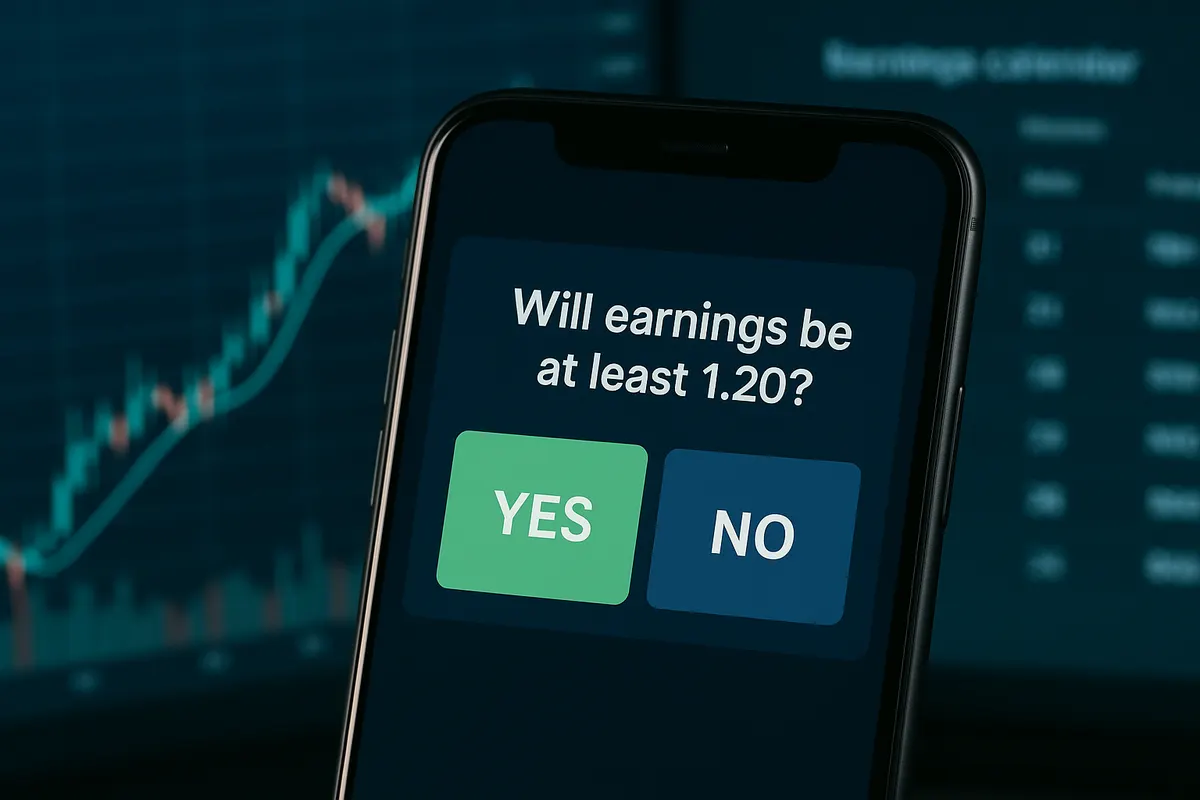
A yes-or-no bet on a line in an earnings report
The Robinhood Cboe earnings contracts are binary derivatives that pay a fixed amount if a specific company metric lands where you said it would, and nothing if it doesn’t. Robinhood announced at its third annual HOOD Summit in Houston that it will be the first retail broker to list them, pending regulatory approval, with an expected debut in October.
That one-line definition is where the simplicity ends. Because these contracts are structured as securities on a registered US exchange rather than as event contracts on a futures venue, they sit in a different regulatory lane than the sports and election markets most retail traders already know. And because the payoff is all-or-nothing, they behave less like owning a stock and more like taking a price on a proposition. Same screen, same app, very different risk profile.
What Cboe filed, and what it covers
In July, Cboe Global Markets asked the US Securities and Exchange Commission to approve binary options tied to roughly 100 key performance indicators across 23 public companies. The names expected in that group include Apple, Tesla, Coinbase Global, SpaceX and Robinhood itself.
The interesting part is what the contracts reference. Rather than tracking a share price, they settle on discrete operational data points: iPhone sales, SpaceX rocket or satellite launches, deliveries of a specific Tesla model. Cboe calls these KPI event contracts, and in its own filing language it argues they belong inside the securities market’s “transparency, oversight and investor protections,” including federal preemption of state securities registration requirements. The subtext is a direct comparison with the event contracts already trading on CFTC-regulated designated contract markets.
Both Cboe and Robinhood are waiving fees on the KPI contracts through the end of the year. That matters more than it sounds, and I’ll come back to it.
Why the binary structure changes the math
A standard listed option has a continuous payoff. Get the direction right by a lot and you make a lot; get it right by a little and you make a little. A binary contract has two outcomes and only two. It resolves to its full value or to zero.
That makes the price itself a probability statement. A binary trading at 30 cents on the dollar is the market saying there’s roughly a 30% chance the stated condition is met, before costs. Buy it and you risk 30 to make 70. Sell it and you risk 70 to make 30. There is no partial credit for being nearly right, and no way to be rescued by time or a later recovery in the underlying, because settlement is pinned to a published figure on a known date.
Two consequences follow. First, your edge has to come from genuinely better information or a better read on a specific number, not from general bullishness on a company. Second, the structural cost is the bid-ask spread plus any exchange and brokerage fees. Spreads on narrow, newly listed markets are usually wider than on liquid equity options, and a wide spread on a binary is expensive in percentage terms. The fee waiver masks part of that cost until it expires.
Exact contract specifications, tick sizes and settlement terms depend on what the SEC ultimately approves, so treat any specific figure you see before launch as provisional. You can follow the regulatory record through the SEC.
How the three products compare
| Feature | Cboe KPI binary option | Listed equity option | Event contract on a DCM |
|---|---|---|---|
| Primary regulator | SEC (securities exchange) | SEC (securities exchange) | CFTC (designated contract market) |
| What it references | A company KPI, e.g. unit sales or deliveries | The share price | Sports results, elections, corporate actions, price levels |
| Payoff shape | Fixed: full value or zero | Continuous, scales with the move | Fixed: full value or zero |
| Main cost to the trader | Spread plus fees (fees waived into year-end) | Spread, commissions, time decay | Spread plus platform fees |
| Typical use | Position on one disclosed number | Directional or hedging exposure | Speculation on a discrete outcome |
What is actually driving this launch
Prediction markets are the fastest-growing business line in Robinhood’s history, and most of that growth has come from sports event contracts. Bernstein analysts have projected the segment’s revenue could reach $1.7 billion by 2028. Sports brought volume, but it also brought a customer base that doesn’t necessarily overlap with the people who opened a Robinhood account to trade markets in the first place.
KPI contracts are the bridge back. They give an equities-minded user something to do around an earnings date that isn’t buying a weekly call. Most corporate event contracts available today are tied to share price moves or to corporate actions such as mergers, acquisitions and IPO filings. A contract on iPhone units or Tesla deliveries is a different question, closer to fundamental research than to chart reading.
There’s a competitive layer too. Prediction market venues have been courting professional money, with Polymarket hiring a former Goldman Sachs partner to lead institutional growth. Cboe’s pitch, that these products belong on a registered securities exchange, is a positioning argument aimed squarely at that audience and at regulators. The Robinhood listing was announced alongside weekend trading in select equities and ETFs and plans for AI trading bots, which tells you how the broker sees its roadmap: more surface area, more hours, more ways to take a view.
Where investing stops and speculation starts
The honest answer is that the line is thinner here than the packaging suggests. SEC regulation addresses market integrity, disclosure and oversight. It does not change the shape of the payoff or the odds you’re accepting. A binary contract on a quarterly number is a short-horizon wager on a single data release, and calling it a security doesn’t make it a long-term investment.
Three specific traps worth naming:
- Mistaking the price for a forecast you can trust. Thin, new markets can be mispriced in both directions. A 20-cent contract is not a guarantee that something is unlikely; it’s what the available buyers and sellers agreed on, and early liquidity will be shallow.
- Underrating settlement detail. Binaries live and die on definitions: which figure, as reported by whom, on which date, rounded how. Read the contract spec before you read the market.
- Treating the fee waiver as free trading. The spread is still a cost, and when the waiver lapses at year-end, the economics of frequent small positions change.
A sane way to approach them
If you plan to trade these when they list, a few habits do most of the work:
- Size positions as though every one of them could go to zero, because by design some will. Decide in advance what percentage of your account goes to binaries in total, not per trade.
- Convert the price into a probability and ask whether you genuinely disagree with it. If you can’t articulate why the market is wrong about a number, you don’t have a trade.
- Read the settlement terms on the specific KPI, including the data source and resolution date.
- Check the spread before the headline. On a binary, a few cents of spread is a large share of your potential return.
- Keep binaries separate in your own records from your long-term holdings. Blending them makes it very hard to see what’s actually working.
Short-horizon, all-or-nothing products are closer to speculation than to portfolio building, and they carry a real risk of losing the full amount staked. Use only money you can afford to lose, set your own limits on how much and how often, and if trading them stops feeling like a decision and starts feeling like a compulsion, step away and use the account controls or support resources available to you.
Common questions
When do the Robinhood Cboe earnings contracts launch?
Cboe has indicated an October debut on Robinhood, pending SEC approval, which would line up with the start of third-quarter earnings season. Dates can slip if the regulatory process takes longer.
Which companies are included?
Cboe’s filing covers around 100 KPIs across 23 public companies. Apple, Tesla, Coinbase Global, SpaceX and Robinhood are among the expected names.
Are these the same as the sports event contracts on Robinhood?
No. Both are binary, but the KPI products are securities traded on Cboe’s SEC-registered exchange, while sports event contracts trade on CFTC-regulated designated contract markets.
Do they cost anything to trade?
Cboe and Robinhood are waiving fees through the end of the year. The bid-ask spread is still a cost, and fee arrangements after the waiver period have not been detailed.


Leave a Reply