
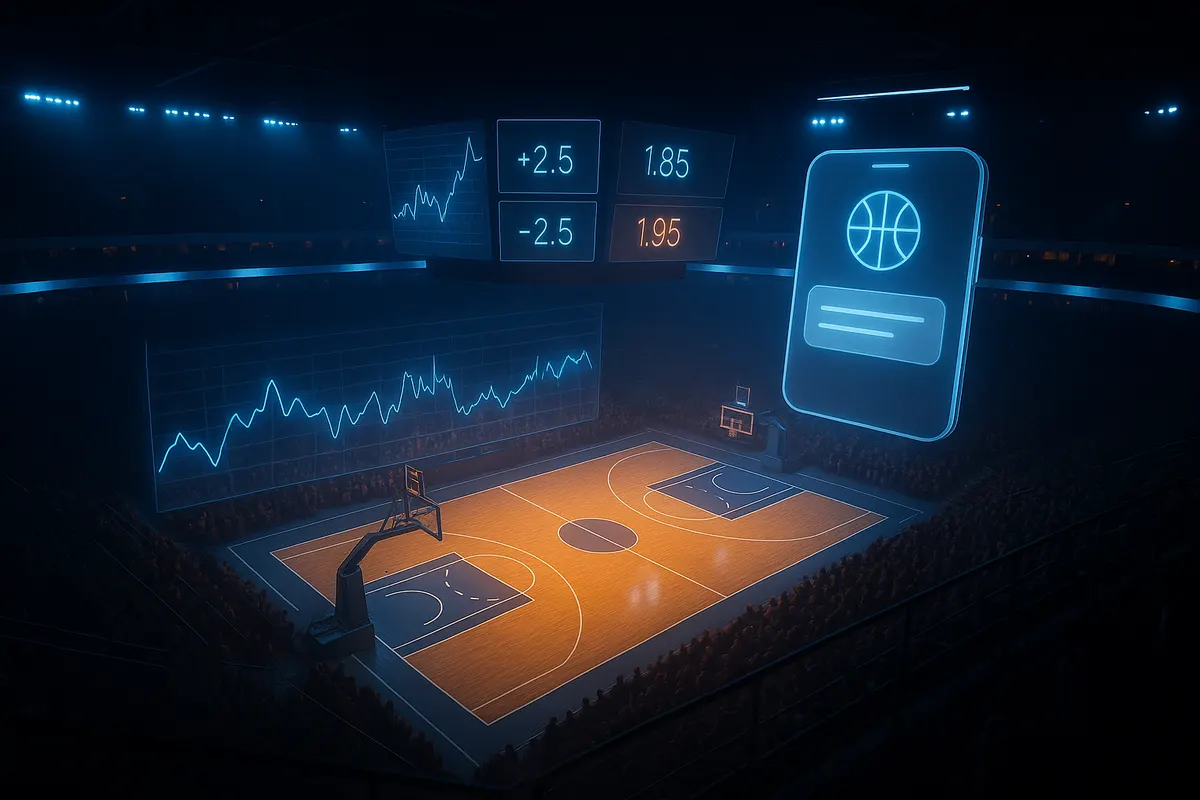
Third quarter, 90 seconds on the clock, and your phone already knows what you want
A player steps to the free throw line. Before he’s finished bouncing the ball, your phone buzzes: a price on whether he sinks both, a boosted multiplier on a same game parlay you half-built at halftime, a nudge to use the free bet sitting in your account. None of that timing is luck. It’s the visible edge of a machine that has been studying you all season, and it’s the reason a recent SBC News discussion reached for Michael Jordan when describing the Sportradar DraftKings audience strategy.
The framing was “be like Mike”, and it’s less of a slogan than it sounds. Jordan’s advantage wasn’t only athletic. It was preparation, repetition, and an obsessive read on the matchup in front of him. Apply that to a betting business and you get the two things both companies now spend most of their energy on: knowing exactly who is watching, and getting the right product in front of them within seconds of the moment that created the interest.
Let’s follow that free throw notification all the way back through the system, because the chain tells you more about where the industry is heading than any press release will.
What a Jordan mindset actually translates to in a betting product
Strip out the motivational poster version and the comparison holds up in three practical ways.
- Film study becomes behavioural data. Jordan watched tape on defenders. A sportsbook watches which markets you open, how long you hover before staking, which sports you drift toward in the off-season, and which notifications you mute. That’s the raw material for personalisation.
- Repetition becomes iteration. Nobody ships a winning in-play product once. Pricing models, cash-out triggers, parlay builders and onboarding flows get tested, measured and rebuilt, over and over, the same way a jump shot gets grooved.
- Knowing the matchup becomes segmentation. The opponent isn’t only the sportsbook across the street anymore. It’s every app competing for the same two hours of your attention: streaming, fantasy, social video, free-to-play prediction games.
That last point is the real substance of the story. Betting audience evolution is no longer about converting a wave of brand-new customers in a newly regulated state. In mature markets, that wave has already broken. Growth now comes from deepening engagement with people who already have an account, which is a completely different sport to play.
Inside the Sportradar DraftKings audience strategy: two very different jobs
It helps to be precise about who does what, because “audience strategy” gets used loosely and the two companies sit at different points in the chain.
Sportradar is a sports data and technology business. It collects and distributes official match data under rights agreements with leagues, prices and manages odds feeds for operators, runs integrity monitoring across thousands of events, and sells marketing and audience technology that helps operators and rights holders reach fans. Its customers include sportsbooks, media companies and the leagues themselves.
DraftKings sits at the front of the chain, facing you. It owns the app, the brand, the promotions, the parlay builder, the push notifications and the relationship with your wallet. It buys or builds the data and pricing that make its markets possible, then competes on how that gets packaged.
Here’s the same free throw notification mapped across the layers it passed through.
| Layer | Typical owner | What you experience |
|---|---|---|
| Event capture in the venue | Data rights holder / collector | Scores and possessions updating almost live |
| Low-latency feed and odds modelling | Data and trading suppliers such as Sportradar | An in-play price that exists for seconds |
| Risk and integrity oversight | Supplier plus operator trading team | Markets that suspend, reprice or vanish |
| Product and pricing presentation | Operator (DraftKings) | Parlay builder, boosts, cash-out button |
| Audience targeting and messaging | Operator marketing plus ad tech partners | The push notification that reached you at the line |
Once you see it laid out, the Jordan analogy stops being decorative. Every layer in that table is a practice rep. Shave latency and more in-play markets stay open. Improve the model and the parlay builder can offer correlated legs it previously refused. Sharpen the segmentation and the notification lands for the fan who wanted it rather than the one who turns off alerts for good.
Follow the bet: the sequence behind a single in-play price
- A courtside collector or automated system logs the foul and the shooter within a second or two.
- That event hits a feed, where a model updates the probability of the next scoring sequence and converts it into odds, with a margin built in.
- Risk controls check exposure, suspend anything stale, and flag unusual patterns to integrity monitoring.
- The operator’s front end decides what to show you, which depends on your history: a single prop for one user, a four-leg same game parlay for another.
- A messaging engine decides whether to interrupt you at all, and with what incentive.
- You tap, the price revalidates, and the market closes as the ball leaves his hands.
Steps four and five are where the competitive obsession now sits. The pricing part of the business is mature and heavily commoditised. The audience part is not. That asymmetry explains why a data company talks about marketing technology and why an operator talks about content, media and free-to-play games.
Where the margin hides while you’re being entertained
Personalisation is genuinely useful. It can also quietly steer you toward the products with the most built-in edge, so it’s worth knowing the arithmetic.
Take a simple two-way market priced at 1.91 on each side. Each price implies a 52.4% chance (1 ÷ 1.91), so the book is pricing 104.8% of probability into a 100% event. That extra 4.8% of implied probability is the overround, and it works out to roughly a 4.5% margin on a balanced book. You’re not being cheated; you’re paying for the market to exist.
Now combine legs. Every additional selection in a parlay stacks another slice of margin on top of the last, which is exactly why multi-leg and same game products are promoted hardest. Same game parlays also involve correlated outcomes, so they’re priced by model rather than by simple multiplication, and the effective margin on them is typically higher than on a single bet. The entertainment value is real. So is the cost.
Boosts and free bets follow the same logic. A boost usually reduces the margin on a market the book wants volume in, not on the one you’d have chosen anyway. A free bet frequently returns winnings only, with the stake withheld, which makes it worth less than its face value. Read the terms once properly and you’ll read every promotion faster afterwards.
How to use all this as a bettor rather than be used by it
You can’t opt out of being an audience, but you can change how you respond to the pitch.
- Treat a well-timed notification as marketing, not as information. The timing tells you the book is ready, not that the bet is good.
- Compare the price before you tap a boost. A boosted leg inside a worse-priced parlay is not a bargain.
- Decide your stake before you open the app, not during a free throw. In-play markets are designed for speed, and speed is where discipline goes to die.
- Check what a free bet actually returns, and what turnover it requires, before you count it as value.
- Set deposit, loss and session limits in the account settings. They work in your favour precisely because they’re boring and automatic.
The honest summary of the Jordan framing is this: the operators and suppliers are the ones putting in the practice reps, and the house edge means they profit over time whether any individual session goes well or badly. Nothing in a personalisation engine changes that maths. What it changes is how comfortable the experience feels while the maths does its work.
If you want the original trade-press framing of the discussion, it ran in SBC News. Read it as what it is: an industry conversation about getting better at reaching you. Knowing that is the one genuine edge available on your side of the screen.
Betting should be entertainment you can afford to lose. If it stops feeling that way, use the deposit limits, cool-off and self-exclusion tools in your account, and contact a national gambling support service. Over-18s only.


Leave a Reply