
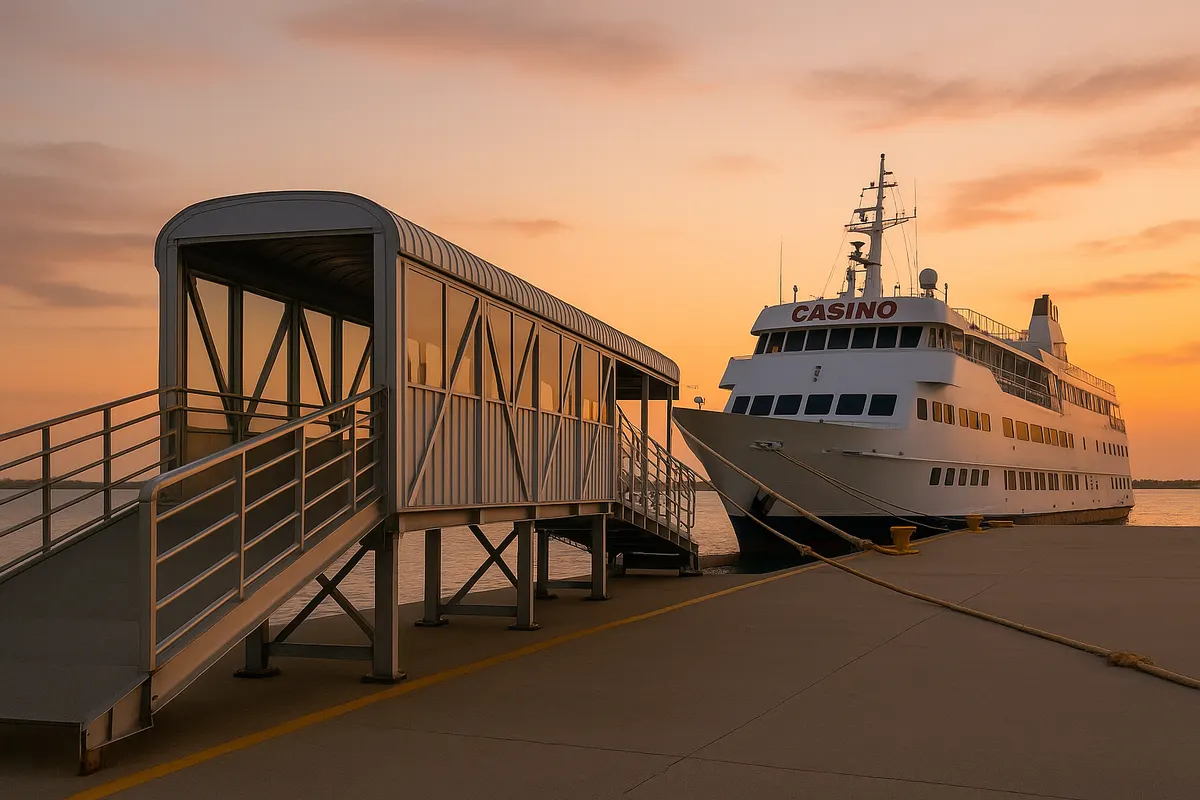
On a normal Tuesday, the crew of Victory I would work two sailings out of Terminal B-2 at Port Canaveral: cards shuffled before departure, slot floor opened once the boat crossed into international waters, back at the dock in time to turn the ship around and do it again. Since the sailings on Sept. 28, nothing. Victory Casino Cruises pulled its only vessel for what it describes as an extended dry dock, and employees say they have been furloughed while it sits out of service.
That sentence is the whole story in miniature, and it’s worth unpacking, because a casino cruise ship dry dock is the one scenario where a gambling business can have strong demand, a loyal customer base and zero revenue at the same time. Victory has sailed from Port Canaveral for 16 years and carried more than three million gamblers. None of that helps when the hull is out of the water.
Two kinds of dry dock, and only one of them is manageable
Every commercial passenger vessel comes out of the water on a schedule. Hull inspections, propulsion and machinery surveys, and certification work are required on cycles set by classification societies and flag-state regulators, so operators budget for the yard time and plan the calendar around it. Crews often know months ahead. Some get reassigned, some take leave, some get paid retention.
Then there’s the other kind. Victory’s own description is the tell: the company had hoped to resume sailing sooner, but “additional necessary work has extended our time out of service.” The work concerns the boat’s mechanical systems, and the operator has been clear that it is not cosmetic. No new carpet, no new lighting, no new gaming machines. Passengers will step back aboard the same interior they left.
That distinction matters more than it sounds. Cosmetic refits have a scope you can price and finish. Machinery work has a habit of uncovering more machinery work once the covers come off, which is exactly why no return date has been offered. A routine haul-out can be measured in weeks. An open-ended mechanical job is measured in “when it’s done.”
Furlough versus layoff: what cruise crew pay actually looks like
Victory’s public message, posted by Captain Tim, dealt with passengers and reservations and said nothing about staff. Employees filled in the gap themselves: they’re on furlough.
A furlough is a temporary, mandatory leave of absence without pay. Some employers keep benefits running through it, some don’t. Furloughed workers in the US can generally apply for unemployment benefits, and health coverage continuation under COBRA is available through the US Department of Labor. The job technically still exists. The paycheque doesn’t.
Here’s how the two outcomes compare from a worker’s side of the table:
| Furlough | Layoff | |
|---|---|---|
| Pay | None during the leave | None after separation |
| Employment status | Still employed, not working | Employment ended |
| Benefits | Sometimes continued by the employer | Typically end, COBRA available |
| Unemployment claim | Generally eligible | Generally eligible |
| Return to the job | Expected, but not guaranteed or dated | Requires rehire |
On paper, furlough is the softer option, and for a company that wants its trained dealers, cage staff, bartenders and deck crew back the moment the ship sails, it’s the rational one. Dealers who can run craps and baccarat on a moving vessel aren’t hired off the street in an afternoon. But “softer” is doing a lot of work in that sentence. A furlough with no end date asks tipped and hourly staff to wait out a shipyard schedule on unemployment benefits, and tipped income on a casino boat is usually the larger half of the earnings.
Why a single-ship operator has nowhere to put anyone
This is where the comparison gets instructive. The same maintenance event lands very differently depending on the shape of the business.
| Single-ship day cruise | Multi-ship cruise line | Land-based casino | |
|---|---|---|---|
| Revenue during the work | Zero | Continues on other vessels | Continues; sections close in phases |
| Staff options | Furlough or layoff | Transfer to another ship | Reassign within the property |
| Customer options | Refunds, wait for the return | Rebook another sailing | Play a different part of the floor |
| Timeline pressure | Severe, every idle day costs the full business | Absorbed across the fleet | Low |
A land-based casino renovating its slot floor ropes off a section and keeps the cage open. A big cruise line moves crew to another hull. Victory I is the company’s lone ship, so there is no second deck to move anyone onto and no alternative sailing to rebook customers into. One vessel out of commission is one hundred percent of the operation out of commission, and the people with the least financial cushion absorb the shock.
What the pause looks like from the passenger side
Players lose a very specific product here, not just a venue. Before the dry dock, Victory I ran twice daily, Tuesday through Sunday, at $25 per person to board, with group discounts at 10 or more. Gambling opened once the boat reached international waters, roughly 45 minutes after departure, because US territorial waters end 12 nautical miles offshore. Onboard there were more than 600 slot machines plus live dealer blackjack, craps, roulette, poker and baccarat, along with bingo and sports betting. Drinks were complimentary while gambling, with smoking restricted to the open air on Deck 4.
For Floridians without a nearby commercial casino, that 45-minute run is the whole point: the boat is the jurisdiction. Take the boat away and there’s no substitute a few exits up the highway.
On the commercial side, the operator has done the straightforward thing. Paid reservations and deposits are being refunded, and future bookings are on hold until the maintenance finishes. That’s the right call, and it’s also an admission that the company can’t forecast a sail date.
The verdict: the model works until the machinery doesn’t
Weigh the three structures against each other and the day cruise casino comes out as the most exposed by a wide margin. It’s a lean, popular, low-overhead way to offer legal gambling where land-based licences are scarce, and for 16 years it worked for Victory and its passengers. But the entire business rests on a single set of engines passing survey, and there’s no redundancy anywhere in the chain: one ship, one terminal, one crew, one revenue stream.
Players get refunds. The company gets a repaired vessel and, presumably, a grateful customer base when it returns. The crew carries the gap, unpaid, with no date to plan around. That’s the part worth remembering the next time a gambling boat posts a cheerful note about being back soon.
If you had sailings booked, watch the operator’s own channels rather than third-party listings, keep your refund confirmation, and don’t assume a published reopening date is firm until the ship is actually back alongside. And if a trip to the boat is part of your entertainment budget, treat it that way: gamble only with money you can afford to lose, set a limit before you board, and use the deposit and session limits available to you. Support is available through national problem gambling helplines if play stops feeling like entertainment.
Common questions about casino cruise dry docks
How long does a casino cruise ship dry dock take?
It depends entirely on scope. Scheduled hull and certification work can be finished in a matter of weeks. Mechanical repairs that expand once the ship is opened up, as Victory has described, have no reliable timeline, which is why the company has declined to name a return date.
Do furloughed cruise casino workers get paid?
No. A furlough is unpaid leave. Benefits are sometimes maintained by the employer, and furloughed staff can generally file for unemployment benefits and continue health coverage via COBRA.
Is dry dock a sign the operator is closing?
Not by itself. Periodic haul-outs are a legal requirement for passenger vessels. What distinguishes a worrying dry dock from a routine one is an open-ended extension, refunded bookings and furloughed staff, which together signal that the repair scope grew beyond what was planned.
Why does gambling only start once the ship leaves port?
Because the boat has to clear US territorial waters, which extend 12 nautical miles from the coast. On Victory I that took about 45 minutes from departure, at which point the casino floor opened.

Leave a Reply