
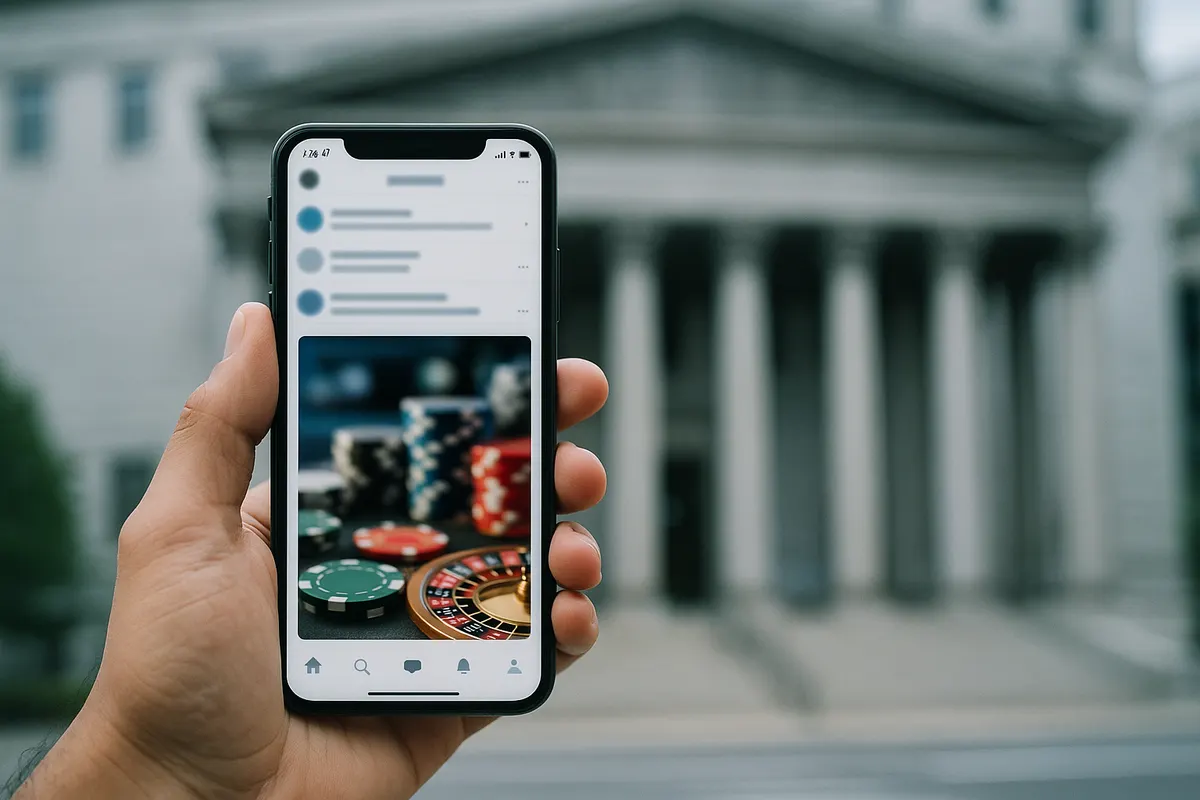
You’re halfway through a football clip on Instagram when the feed cuts to an advert for a casino you’ve never heard of. No licence number, no operator name you recognise, a “claim your bonus” button and a link that bounces through two redirects. You scroll past. Thousands of Dutch users don’t.
That drip of unlicensed promotion is the thing at the centre of the dutch gambling trade body meta case, which has now moved from complaints and correspondence into an actual courtroom. VNLOK, the association representing licensed online gambling operators in the Netherlands, has summoned Meta to court over gambling ads it says are illegal under Dutch law and keep appearing on Facebook and Instagram. If you buy media, run an affiliate site, or hold a licence anywhere in Europe, this is the clearest test yet of who carries responsibility when a platform’s ad system serves a promotion that the local regulator has outlawed.
Here’s how to read it, step by step, and what to do with it.
Step 1: Get the claim right before you form an opinion
Strip the story back and it’s simple. VNLOK’s members pay for Dutch licences and live under some of the tightest gambling advertising rules in Europe. They argue that unlicensed operators are reaching the same Dutch audience through paid social, that Meta profits from serving those ads, and that the platform has not done enough to remove them or stop them reappearing. Escalating to a court summons shifts the dispute from “please take these down” to a formal civil claim asking a judge to decide whether Meta’s conduct is unlawful.
Two things this is not. It isn’t a regulator enforcement action; the Kansspelautoriteit (KSA) has its own powers and its own track record of going after parties that promote unlicensed sites. And it isn’t a case about whether gambling ads should exist at all. It’s a case about illegal ones, brought by the legal operators who lose customers to them.
Why would a trade body sue instead of waiting for the regulator? Because civil litigation can target the distribution channel directly. A regulator fining an offshore operator in a jurisdiction with no assets in the Netherlands achieves very little. A court order touching the ad platform touches the pipe.
Step 2: Understand the Dutch rulebook that makes these ads illegal
You cannot judge the Dutch position without the regulatory backdrop. The Netherlands opened a licensed online market in October 2021 under its Remote Gambling Act. Offering online gambling to Dutch residents without that licence is illegal, and so is advertising for an unlicensed offer. From there, the restrictions on even the legal operators tightened fast.
| Measure | Introduced | Practical effect |
|---|---|---|
| Licensed online market opens | October 2021 | Legal supply route created; unlicensed offers remain prohibited |
| Ban on role models in gambling ads | Mid-2022 | No athletes, celebrities or influencers fronting campaigns |
| Ban on untargeted advertising | July 2023 | Mass-reach channels like TV, radio and public display largely closed; online ads must be targeted away from under-24s |
| Phase-out of sponsorship | From 2024, completed 2025 | Shirt sponsorship first, then event and venue deals |
Read that table and the grievance writes itself. Licensed Dutch operators have had their advertising channels narrowed year after year, while an unlicensed advert can still slide into the same user’s feed with no licence, no age targeting discipline and no responsible gambling messaging. That asymmetry is the commercial engine behind this meta legal dispute, and it’s the reason netherlands gambling regulation keeps producing friction with global platforms.
Step 3: Work out where platform liability actually sits
This is the part worth your attention, because the answer isn’t settled. Under the EU’s Digital Services Act, very large online platforms, Facebook and Instagram included, carry obligations around illegal content: notice and action mechanisms, transparency on advertising, and risk assessments covering how their systems are used. What the DSA does not do is hand you a neat formula for how fast a platform must act on paid gambling ads that breach one member state’s licensing law, or how hard it must work to stop the same advertiser coming back under a new account.
A Dutch court looking at this will have to weigh roughly three questions:
- Did Meta have clear, specific notice that identified ads were unlawful under Dutch law?
- Was the response adequate, or did the same advertisers reappear through new pages and creatives?
- Does accepting payment for a prohibited ad put a platform in a different position from a neutral host of user posts?
That third question is the interesting one. Paid distribution is an active commercial act. If a judge treats it that way, the practical standard for platforms across igaming compliance europe moves, and other licensed-market trade bodies will notice.
Step 4: Audit your own exposure this week
Don’t wait for a ruling to tidy your house. Whatever the outcome, platforms respond to litigation pressure by tightening enforcement, and blunt enforcement catches compliant advertisers too. A few practical moves:
- Check your licence coverage per market. Every paid campaign should map to a jurisdiction where you hold a licence or where promotion is lawful. Geo-targeting is part of your compliance record, not just a media setting.
- Document your age and audience exclusions. Dutch rules require targeting away from young adults. Keep evidence of the settings you used, with dates. “We think we excluded them” is not a defence.
- Review your affiliates’ creatives, not just their links. If a partner runs social ads promoting your brand into a market where you aren’t licensed, that’s your problem on paper and in practice.
- Pull your platform ad library records. Meta’s ad transparency tools let you see what’s running. Use them on your own brand and on anyone using your name.
- Agree an escalation route. Decide now who files the platform report, who notifies the regulator, and who keeps the evidence pack when you find someone cloning your brand.
Step 5: Report illegal online gambling ads when you see them
If you’re a player rather than an operator, you still have a lever. Use the platform’s in-ad reporting option to flag the advert, and take a screenshot that captures the advertiser name, the creative and the destination link. In the Netherlands, concerns about unlicensed operators and their promotion can be raised with the KSA. Specific, documented reports are what make notice-and-action work; vague complaints get closed.
A practical safety point: unlicensed sites sit outside the Dutch consumer protections that come with a licence, including the national self-exclusion register, mandatory deposit limits and the complaints route. If a gambling ad in your feed doesn’t lead to a licensed operator, the risk you’re taking isn’t only about odds. Gambling always carries a built-in house edge and should never be treated as a way to make money. If it stops being entertainment, use deposit limits, cool-off periods or self-exclusion.
What to watch next
Civil cases of this size move slowly, and the summons is the start of a process, not the end of one. Three signals will tell you which way it’s heading: whether Meta changes its gambling ad verification for the Dutch market before a judgment, whether the KSA or Dutch policymakers publicly back the trade body’s framing of platform responsibility, and whether trade associations in other licensed markets file parallel claims.
The underlying point survives any verdict. Licensed operators in Europe now compete against unlicensed supply whose main distribution channel is paid social, and gambling advertising rules written for broadcast and billboards are being tested against ad systems that can serve a new creative to a new audience in minutes. The dutch gambling trade body meta case is the first serious attempt to make that fight the platform’s problem too.
FAQ
What is the Dutch gambling trade body Meta case about?
VNLOK, which represents licensed Dutch online gambling operators, has taken Meta to court over gambling ads it says are illegal under Dutch law and continue to appear on Facebook and Instagram. The claim concerns Meta’s responsibility for distributing those paid ads.
Is advertising unlicensed gambling illegal in the Netherlands?
Yes. Offering online gambling to Dutch residents without a Dutch licence is prohibited, and promoting such an offer is also unlawful. The KSA has pursued parties, including promoters and affiliates, that advertise unlicensed operators.
Does this affect operators outside the Netherlands?
Potentially. A ruling on how much a platform must do to block illegal gambling ads would be read closely across igaming compliance europe, and platforms tend to apply enforcement changes broadly rather than market by market.
What should affiliates do now?
Match every paid campaign to a market where the promoted brand is licensed, keep records of geo and age targeting, and stop running social ads into restricted markets. Platform crackdowns rarely distinguish between careless and deliberate breaches.


Leave a Reply